

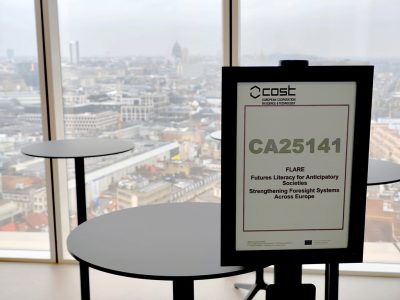
Doctoral students at Bialystok University of Technology can join the international FLARE research network and benefit from opportunities to obtain funding for research visits abroad, conference participation, training activities and collaboration with researchers from across Europe. The four-year COST Action CA25141 – Futures Literacy for Anticipatory Societies – Strengthening Foresight Systems Across Europe (FLARE) began on 19 October 2026 and is open to new participants.
FLARE is a European research collaboration network dedicated to developing futures literacy and foresight methods. Its aim is to strengthen the ability of societies, institutions and organisations to understand ongoing changes, analyse alternative future scenarios and make decisions under conditions of uncertainty.
The Action brings together researchers, educators and practitioners working in fields including management, education, innovation, technological transformation, public policy and socioeconomic development. Owing to its interdisciplinary nature, opportunities for collaboration within FLARE are not limited to doctoral students specialising directly in foresight research.
What opportunities does FLARE offer doctoral students?
The European Cooperation in Science and Technology (COST) programme primarily supports international research collaboration, skills development and researcher mobility. Within FLARE, doctoral students will be able to apply for the following activities:
- Short-Term Scientific Missions (STSMs) – funded visits to research institutions abroad, offering opportunities to learn new research methods, work with experts and carry out specific research tasks. Such visits can provide valuable support for research conducted as part of a doctoral dissertation.
- Training Schools – international training courses and workshops delivered by specialists from various countries. They enable participants to develop new methodological skills, become familiar with research tools and establish contacts with other early-career researchers.
- Conference grants – support for participation in international scientific conferences, including grants for Young Researchers and Innovators (YRI), researchers from Inclusiveness Target Countries (ITC), and grants aimed at disseminating the results of the Action.
- Virtual Mobility Grants – support for international research collaboration without the need to travel, for example through joint analyses, the development of research tools or the preparation of scientific materials.
- Scientific meetings and international workshops – opportunities to participate in expert groups, exchange experience and develop joint research outputs.
Participation in the network may also facilitate joint publications, contacts with prospective research partners and the development of further international projects.
Important: Membership in a FLARE Working Group does not automatically entitle participants to funding. Individual visits, training activities and grants are organised in accordance with the Action’s work plans, available budget and applicable selection procedures.
What do the FLARE Working Groups focus on?
The Action is organised around four international Working Groups:
- WG1 – Theoretical and Methodological Foundations – theoretical and methodological foundations of futures studies, the development of foresight methods and research standards.
- WG2 – Applied Futures: Pathways to Practice – practical applications of foresight methods and futures literacy in education, organisations and public administration.
- WG3 – Futures Literacy Assessment and Evaluation – the development of indicators, measurement methods and tools for evaluating futures literacy and the outcomes of its application.
- WG4 – Capacity and Impact Development – skills development, international collaboration and the dissemination of research results.
Doctoral students from different disciplines can use these groups to develop their research interests, particularly those relating to the future of technology, innovation, socioeconomic systems, organisations or education.
How can you join FLARE?
Doctoral students who were not involved in preparing the Action can also join FLARE Working Groups. Applicants do not need to be members of its Management Committee or represent institutions belonging to the original network of proposers.
Applications are submitted through the European e-COST platform. There is no single overall application deadline: applications may be submitted during the implementation of the Action, and admission is decided by the Management Committee.
To apply, follow these steps:
- Visit the official FLARE Action website and review its objectives and Working Group descriptions.
- Select one or more Working Groups that match your research interests and expertise.
- Log in to the e-COST platform or create a new account.
- Complete the short application form, describing your interests and potential contribution to the selected group.
- Submit your application for consideration by the Action Management Committee. The Committee has up to three months to make a decision.
Before applying, it is advisable to discuss your research interests and potential involvement with the Polish representative on the Management Committee.
Direct application form:
Join the FLARE Working Groups – e-COST
Membership in a Working Group enables participation in the activities of the international network but does not automatically provide financial support. Individual visits, training activities and grants are subject to separate selection procedures and budgetary constraints.
It is worth emphasising that participation in the Action is not restricted to researchers specialising in foresight studies. FLARE may also provide a valuable platform for researchers working in education, innovation, digital transformation, public policy, strategic management, emerging technologies and socioeconomic development.
FLARE – four years of international collaboration
COST Action CA25141 FLARE began on 19 October 2026 with the inaugural meeting of its Management Committee at the COST Association headquarters in Brussels. The Action will run until 18 October 2030.
The initiative aims to establish a lasting European network of researchers and practitioners working in futures studies and to develop shared methods, tools and standards in this field. Particular emphasis is placed on knowledge exchange, the development of early-career researchers’ skills and interinstitutional collaboration.
For doctoral students at Bialystok University of Technology, FLARE offers another opportunity to internationalise their research activities, develop research skills and build professional relationships that may prove valuable both during doctoral dissertation preparation and at later stages of an academic career.
Information and contact
Action: CA25141 – Futures Literacy for Anticipatory Societies – Strengthening Foresight Systems Across Europe (FLARE)
Duration: 19 October 2026 – 18 October 2030
Programme: European Cooperation in Science and Technology (COST)
Contact person at Bialystok University of Technology:
Dr Łukasz Nazarko, member of the Management Committee of COST Action CA25141 FLARE, l.nazarko@pb.edu.pl
Doctoral students interested in participating in the Action, joining its Working Groups or exploring opportunities for international research collaboration may contact Dr Łukasz Nazarko directly.